Discover how Mekong Delta farmers read changing seasons, determine harvest timing, and shape Vietnam rice quality long before the grain is measured.
Vietnamese Rice Quality Begins Before the Grain Is Measured
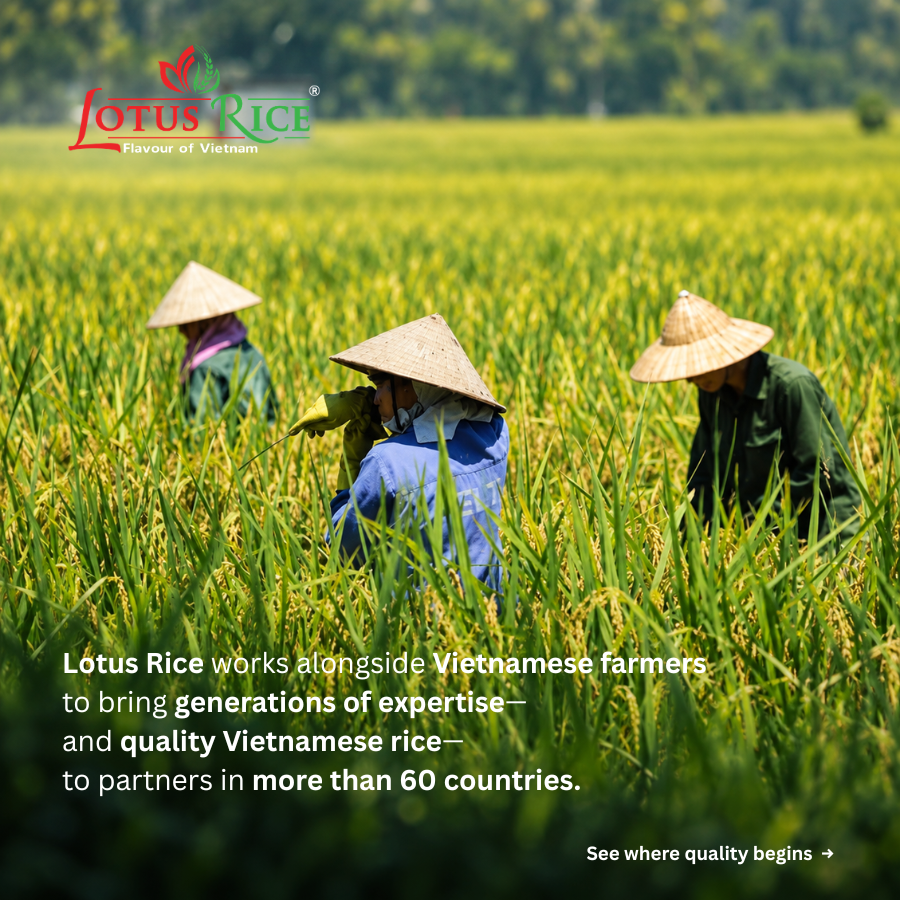
For rice buyers, quality is often expressed through measurable criteria: grain appearance, moisture, and cooking performance. These specifications are essential, but they capture only the result—not the season of knowledge and decisions behind it.
Long before the grain reaches a quality assessment, Vietnamese farmers have already spent months observing the soil, water, weather, and changing crops. Their decisions must respond to the actual conditions of each field and each season, especially as harvest approaches.
This upstream knowledge matters because Vietnam rice quality is not created at the moment it is measured. It begins in the field, where experience helps farmers recognise change and decide when to act.
A Specification Records Quality—Farmers Help Shape It
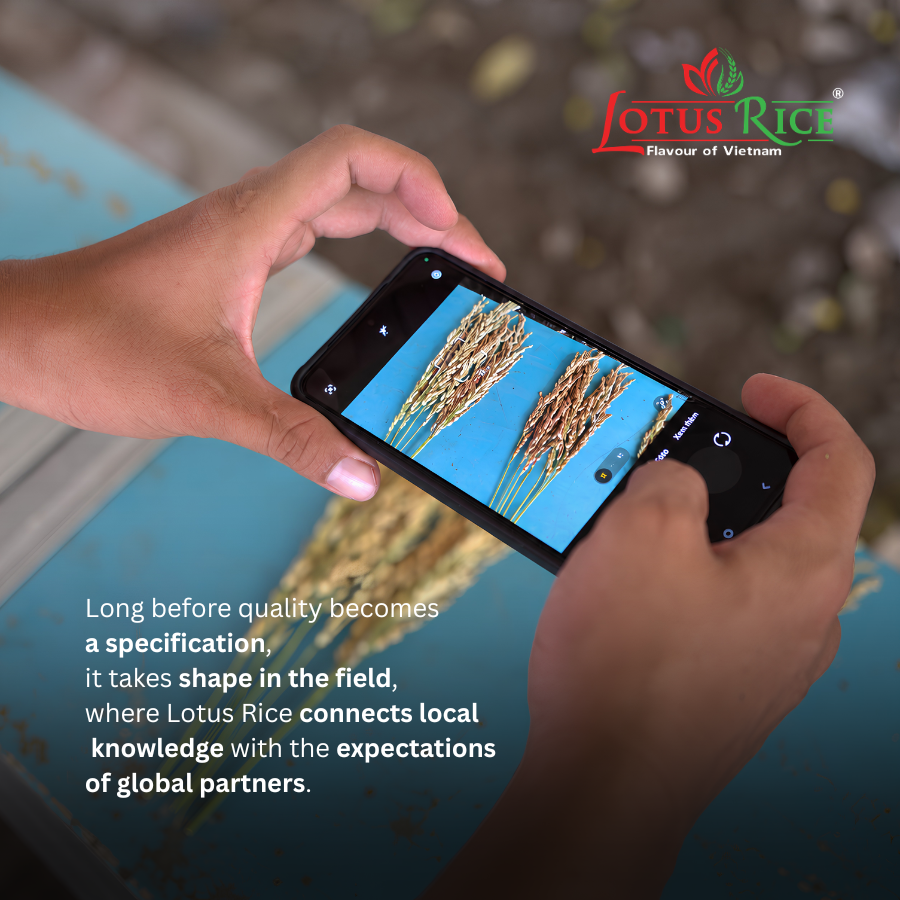
Specifications give buyers a consistent language for discussing rice requirements. They show what the grain is like at a particular stage and help determine whether it is suitable for a market, menu or product application.
However, the qualities being measured have already been influenced by earlier decisions.
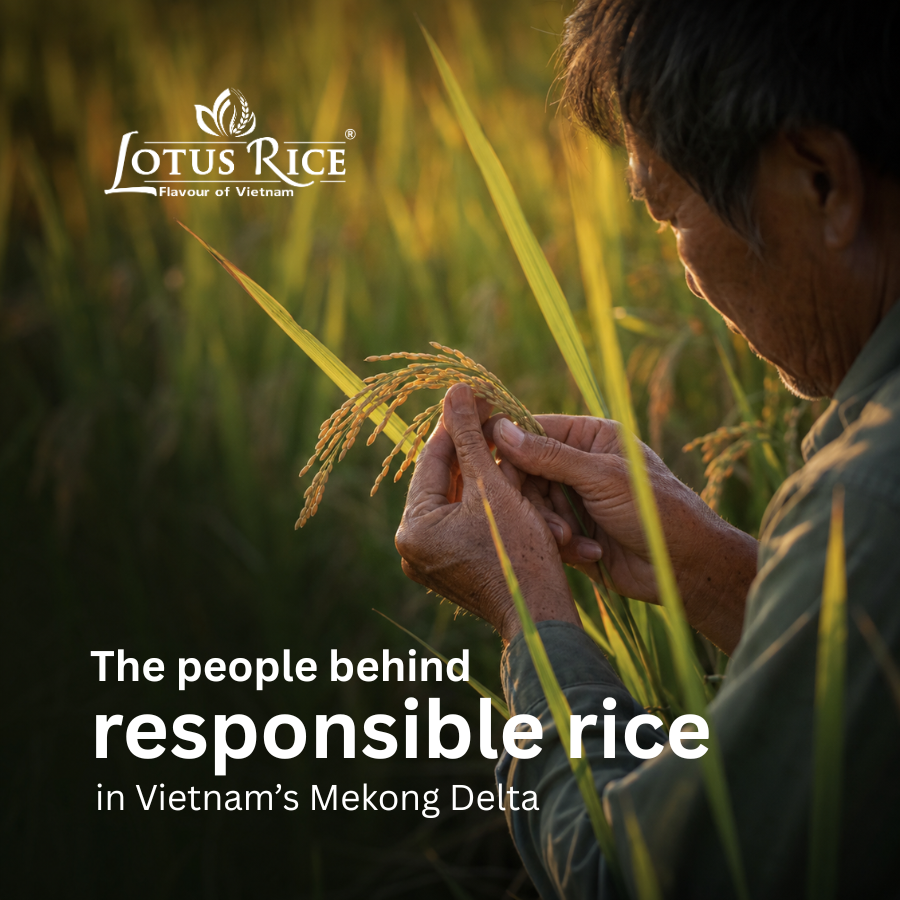
Farmers monitor how the crop develops, how weather conditions change, and how close the grain is to maturity. As the season progresses, they adapt their actions rather than assume that every crop will follow the same timeline.
This is what makes farming experience valuable. It is not simply a set of practices repeated year after year. It is the ability to interpret changing conditions and apply knowledge differently when the crop requires it.
Three Mekong Delta Rice Seasons, Three Different Rhythms
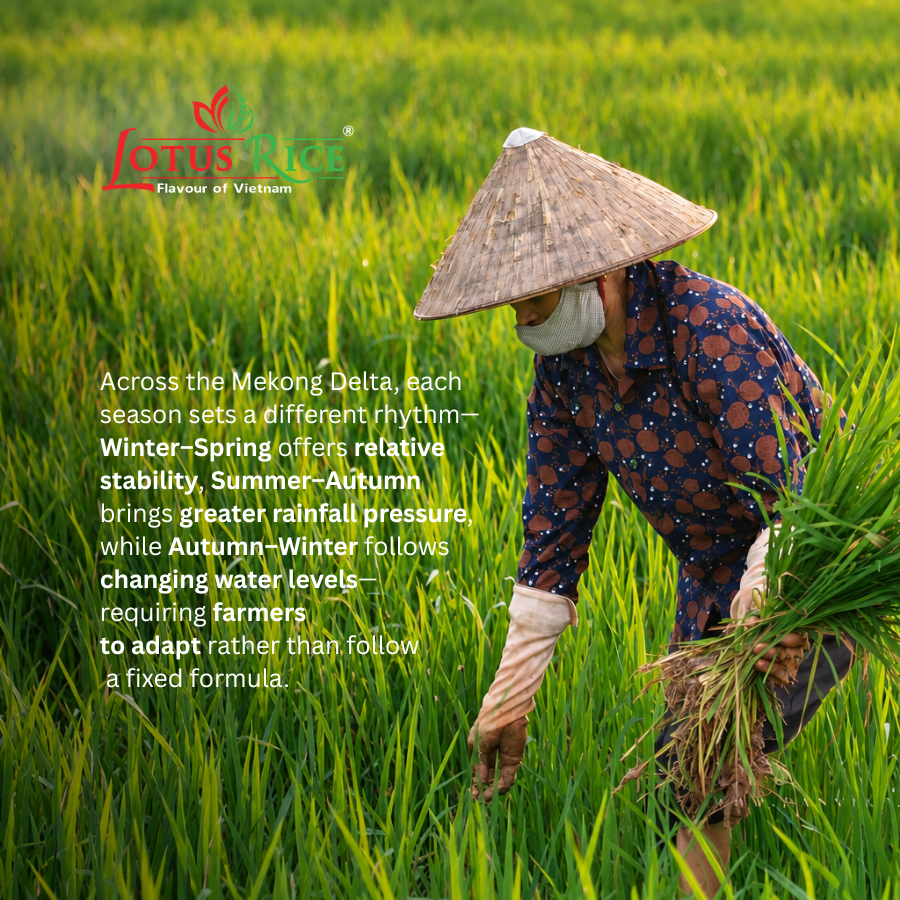
The Mekong Delta can produce several rice crops across the year, but the conditions surrounding each crop are not identical. Winter–Spring, Summer–Autumn and Autumn–Winter each create a different decision-making environment.
Understanding these seasonal differences helps explain why there is no single formula for producing high-quality Vietnamese rice.
Winter–Spring: Relative Stability Still Requires Attention
Winter–Spring generally offers more stable growing conditions than other seasons. This relative stability can support more predictable crop development, but it does not remove the need for close observation.
Farmers continue to monitor maturity, moisture, grain appearance and weather as harvest approaches. A stable season still develops at its own pace, and readiness must be evaluated from the condition of the crop—not from the calendar alone.
Summer–Autumn: Rain Increases the Pressure on Timing
Summer–Autumn brings greater pressure from rainfall and changing weather.
Under these conditions, farmers must consider not only how mature the grain appears, but also how incoming rain may affect the harvest window. Waiting may allow the crop to develop further, while waiting too long can expose it to less favourable conditions.
Experience becomes especially important here because several signals must be assessed together. The decision is rarely based on one visible characteristic.
Autumn–Winter: Mekong Water Levels Shape the Season
Autumn–Winter is influenced more closely by Mekong water levels and the flood season.
As surrounding water conditions change, farmers must remain attentive to both the crop and the wider environment. A practice that worked in one season may need to be adjusted in another because the relationship between the field, weather and water has changed.
This ability to respond is central to Mekong Delta rice production. Farmers draw on knowledge accumulated over years, but every new crop still has to be read on its own terms.
Harvest Timing Is Where Experience Becomes a Quality Decision
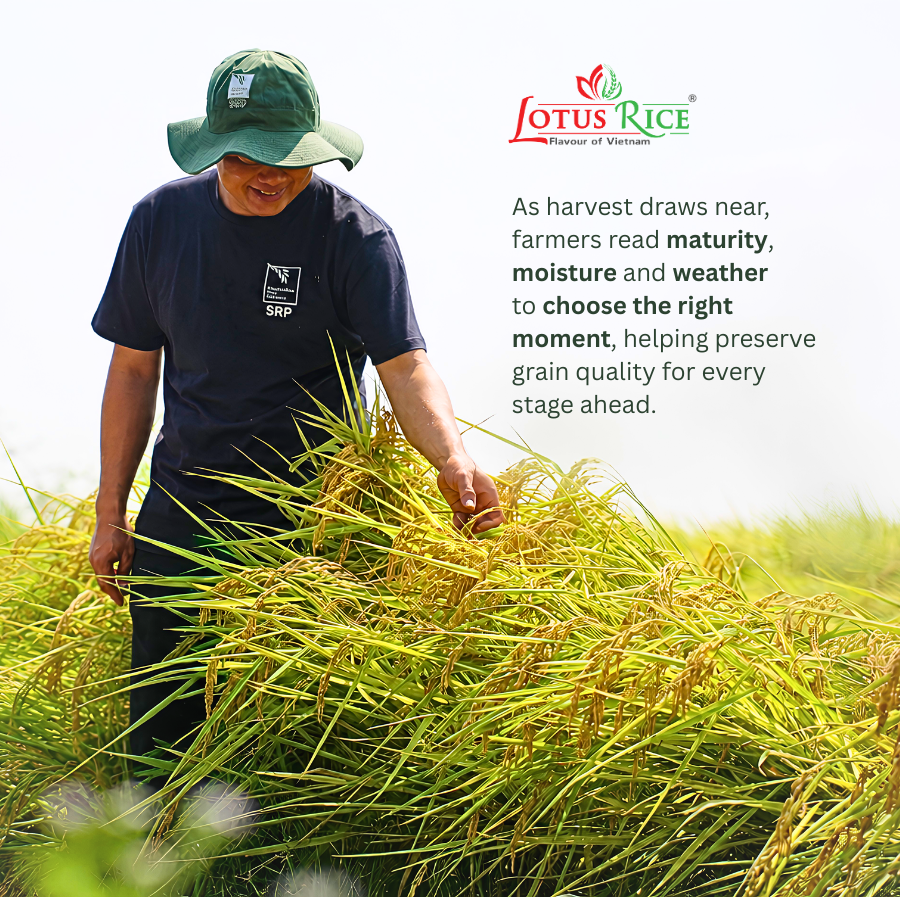
As harvest approaches, farmers bring together several indicators:
- Grain maturity
- Moisture
- Grain appearance
- Current weather
- Expected changes in weather
None of these factors should be considered in isolation.
Harvesting too early or too late can affect the quality carried into the next stage. Choosing the right moment therefore requires more than recognising a mature-looking crop. It requires judgement about how the grain and surrounding conditions are developing together.
This is where generations of experience become practical. Farmers cannot control every variable, but their knowledge helps them make better-informed decisions within changing conditions.
For buyers, this provides a more complete way to understand rice quality: not simply as a number shown on a specification sheet, but as the outcome of connected decisions from field observation to harvest timing.
Why Seasonal Knowledge Matters in Vietnam Rice Sourcing
When evaluating a rice supply, buyers naturally focus on whether the product meets their required specifications. Seasonal knowledge adds useful context to that evaluation.
It can help buyers ask more informed questions:
- Which crop season does the rice come from?
- What conditions shaped that season?
- How was harvest readiness assessed?
- Which grain and cooking characteristics are required?
- How are field observations connected with buyer expectations?
These questions do not replace specifications, sampling or product evaluation. Instead, they help buyers understand the foundation behind the measured quality.
A sourcing conversation becomes more valuable when it connects three elements: the conditions in which the rice was grown, the decisions made before harvest and the performance expected by the buyer.
Lotus Rice Connects Farming Knowledge with Global Markets
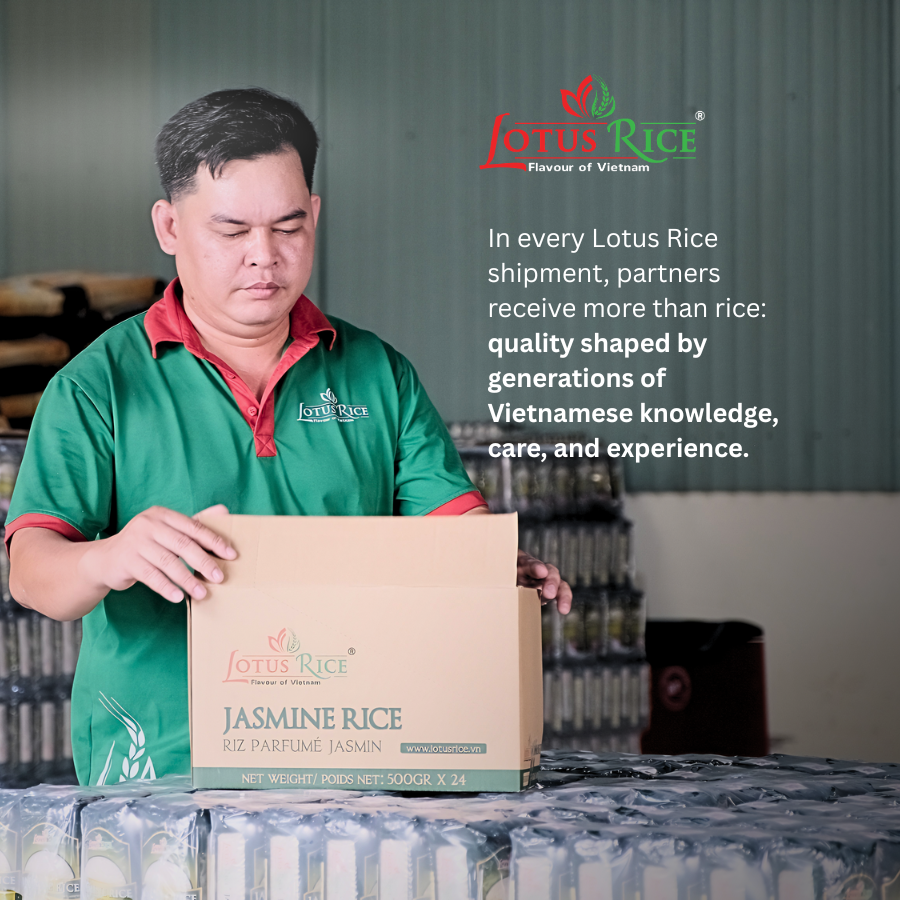
Lotus Rice works alongside Vietnamese farmers to bring their expertise—and quality Vietnamese rice—to partners in more than 60 countries.
Through this connection, knowledge developed in the Mekong Delta becomes part of a wider value chain. Farmers contribute their understanding of the crop and its changing seasons, while international partners bring specific expectations for quality and product performance.
Every shipment therefore represents more than rice moving from Vietnam to another market. It carries the outcome of a full season of observation, adaptation and informed decision-making.
Because quality begins long before it becomes a specification.
CTA: Explore the Knowledge Behind Lotus Rice Quality
Looking for high-quality Vietnamese rice suited to your market or application?
Connect with Lotus Rice to discuss your preferred rice characteristics, technical specifications, cooking requirements, packaging needs and sourcing priorities.
Contact Lotus Rice to request product specifications or schedule a sourcing conversation →
————————————
Website: https://www.lotusrice.vn/
Email: connect@lotusgroup.vn
WhatsApp: (+84 77) 6996 768
Phone: (+84 28) 3622 2236
Head office: No. 52, Street 10, Him Lam Residence, Tan Hung Ward, HCM